Ramalinga Swamigal (1823–1874), known with love as Vallalar, “the great giver”, was a Tamil saint, poet and reformer. He taught that compassion for every living being, which he called Jeevakarunyam, is the truest worship of God, and he lived what he taught: the free kitchen he opened at Vadalur in 1867 still feeds all who come, without asking their caste or creed. His followers honour him as Thiru Arutprakasa Vallalar, the generous one who shines with divine grace.
Timeline of his life
1823
Birth at Marudur
Born on 5 October at Marudur, near Chidambaram, the youngest of five children of Ramaiah Pillai and Chinnammai.
1824
A move to Chennai
His father dies within months of his birth. The family moves to his mother’s home near Ponneri, and from there to Chennai.
1858
Karunguzhi
He leaves Chennai and, after a stay at Chidambaram, settles at Karunguzhi near Vadalur, where he lives for about nine years.
1865
The Sanmarga Sangam
He founds the Samarasa Vedha Sanmarga Sangam, later renamed the Samarasa Suddha Sanmarga Sathya Sangam.
1867
Sathya Dharma Salai
On 23 May he opens the free kitchen at Vadalur and lights its hearth. The same year the first four books of his hymns are printed as Thiruvarutpa.
1872
Sathya Gnana Sabhai
The Hall of True Knowledge at Vadalur opens on 25 January, a Thai Poosam day, with the first darshan of the light.
1873
The flag and the Great Sermon
On 22 October, at Siddhi Valagam in Mettukuppam, he raises the Sanmarga flag and gives his Great Sermon (Peruupadesam).
1874
Into the Light
On 30 January, a Thai Poosam day, he enters his room at Siddhi Valagam and is not seen again. Devotees believe he merged into the Arutperunjothi, the Supreme Grace-Light.
2007
A postage stamp
India issues a commemorative stamp in his honour on 17 August.
2021
A day of compassion
Tamil Nadu declares his birthday, 5 October, Thanipperungkarunai Naal: a day of boundless compassion.
2023
The bicentenary
His 200th birth anniversary is celebrated in Tamil Nadu and across India.
Birth and early life
Ramalingam was born on 5 October 1823 at Marudur, a village near Chidambaram in today’s Cuddalore district. He was the youngest of the five children of Ramaiah Pillai and Chinnammai, with two elder brothers, Sabhapathi and Parasuraman, and two elder sisters.
His father died within months of his birth. His mother took the children to her family home near Ponneri, and the family later settled in Chennai, in the Seven Wells (Ezhu Kinaru) area, where the eldest brother, Sabhapathi, supported them.
Family tradition recalls that when he was five months old his parents carried him to the Nataraja temple at Chidambaram, and that the baby laughed with joy as the camphor flame was shown before the shrine. He later spoke of that moment as his first sight of the Light.
A boyhood of prayer
Sabhapathi arranged lessons for him, including with the Kanchipuram scholar Sabhapathi Mudaliar, but the boy was drawn to worship more than to the classroom. He spent long hours at the Kandaswami temple, Kandakottam, in George Town, and sang his early hymns to its Murugan. His teacher is said to have decided that this pupil needed no ordinary schooling.
His sister-in-law cared for him and gave him a room of his own upstairs. There, meditating before a lit lamp and a mirror, he is said to have had a vision of Lord Murugan. In one of his verses he speaks of all that he had received “from my twelfth year until today”.
Spiritual growth
In Chennai he became known for his devotional verse, and he often walked to the temple at Thiruvottiyur, whose deity many of his early hymns praise. Under family pressure he married his niece, his sister’s daughter, but he did not take up household life.
Over the years his worship grew beyond particular forms and temples. He came to see God as one and formless, present in every being as light, and named that God Arutperunjothi, the Supreme Grace-Light, and Thanipperungkarunai, the boundless and unique Compassion.
Karunguzhi and the Sanmarga Sangam
In 1858 he left Chennai. After a stay at Chidambaram he accepted the invitation of a devotee, Ramakrishna Reddiyar, and settled at Karunguzhi, a village near Vadalur, where he lived for about nine years.
In 1865 he founded the Samarasa Vedha Sanmarga Sangam, a fellowship open to everyone, later renamed the Samarasa Suddha Sanmarga Sathya Sangam. It stood for one God worshipped as light, compassion for all lives, no killing and no meat-eating, and food for the hungry.
In 1867 his disciple Thozhuvur Velayudha Mudaliar, a Tamil scholar, published the first four books (Thirumurais) of his hymns under the title Thiruvarutpa, “the divine song of grace”. The fifth and sixth books, the sixth holding his mature teaching, were published later.
Sathya Dharma Salai, 1867
On 23 May 1867, Vaikasi 11 in the Tamil calendar, he opened a free house of food at Vadalur on land given by the villagers: the Samarasa Vedha Dharma Salai, known today as the Sathya Dharma Salai. Anyone who is hungry is fed there, without being asked about caste, religion or country.
On the first day he lit the kitchen hearth and asked that it never be put out. It has been kept burning ever since, and the Salai still feeds visitors every day with the help of donors and volunteers. Read his teaching on feeding the hungry.
Sathya Gnana Sabhai, 1872
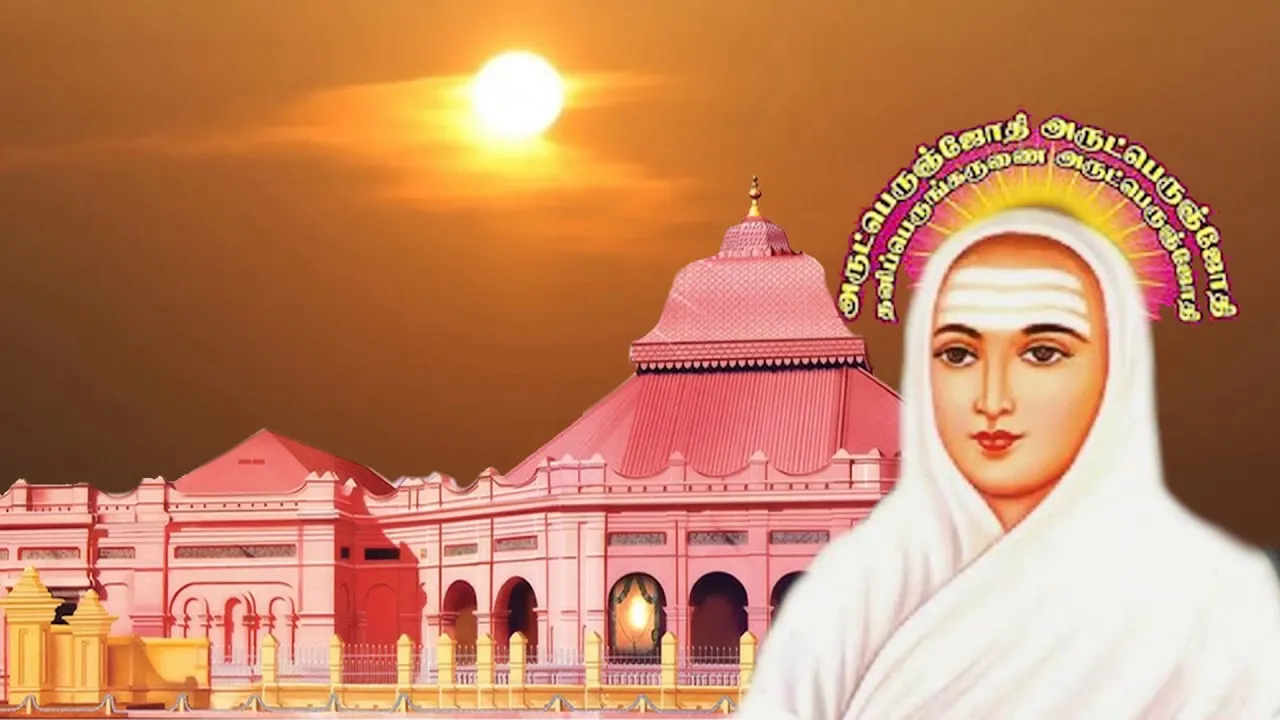
Nearby he built the Sathya Gnana Sabhai, the Hall of True Knowledge, which opened on 25 January 1872, a Thai Poosam day. It is not a temple with an idol: worship is offered to a lamp, the sign of the Arutperunjothi.
The hall is octagonal. Seven screens of different colours hang before the lamp, standing for the veils that hide the soul’s own light, and the enclosure is fenced with a chain of 21,600 links, said to match the number of breaths a person takes in a day. Each year on Thai Poosam the screens are drawn aside one after another, and thousands gather for the Jothi darshan, the sight of the light.
Siddhi Valagam and 1874
In his last years he lived at Siddhi Valagam, a small house at Mettukuppam near Vadalur. There, on 22 October 1873, he raised the flag of the Sanmarga and gave his last public address, the Great Sermon (Peruupadesam). He urged his listeners not to waste their time but to inquire into the truth, and not to rest their faith in the scriptures and customs that had hidden it. (Some accounts give the date as 20 October; the sermon’s own heading, Wednesday, 7 Aippasi of the Srimukha year, matches 22 October 1873.)
On the night of 30 January 1874 he entered his room at Siddhi Valagam, asked his followers not to open the door, and was not seen again. When the room was later opened it was found empty; accounts differ on when that was. The event is recorded in the colonial district books of South Arcot: Garstin’s district manual of 1878 and the district gazetteer of 1906. For his devotees he did not die; he merged into the Arutperunjothi.
His writings
His hymns, about 5,800 verses in six books, are gathered as Thiruvarutpa. Their summit is the Arutperunjothi Agaval, a single poem of 1,596 lines in the sixth book. His prose includes Jeevakarunya Ozhukkam, “the discipline of compassion for living beings”, and Manu Murai Kanda Vasagam, the story of the just Chola king Manu Needhi Cholan. He also edited older Tamil works. Read verses in his own words.
Photographs
Photographs from Wikimedia Commons: Sathya Gnana Sabai by S. Vaishnavi Jyothi (2024), CC BY-SA 4.0; the hall and its entrance by Sodabottle (2012), CC BY-SA 3.0. Resized for the web. The artwork at the top of the page is from Deepam Trust.


Continue reading
- What is Sanmarga? Vallalar’s teachings and principles
- Vallalar in his own words: verses from Thiruvarutpa
Sources
- Ramalinga Swamigal, Wikipedia (English), and இராமலிங்க அடிகள், Wikipedia (Tamil), with the sources they cite.
- Satyagnana Sabha, Vadalur, Wikipedia.
- இராமலிங்க வள்ளலார், Tamil Wiki, drawing on Ooran Adigal’s biography.
- vallalar.org: Birth of Vallalar, Education and boyhood, Dharma Salai, Sathya Gnana Sabai, Siddhi Valagam and பேருபதேசம் (the Great Sermon).
- Thiruvarutpa, the full text of the six Thirumurais (Ooran Adigal’s edition), thiruarutpa.org.
- Richard S. Weiss, “Print, Religion, and Canon in Colonial India: The Publication of Ramalinga Adigal’s Tiruvarutpa”, Modern Asian Studies 49:3 (2015).
- Srilata Raman, The Transformation of Tamil Religion: Ramalinga Swamigal (1823–1874) and Modern Dravidian Sainthood, Routledge (2022), open access.
- Birth anniversary of Vallalar to be celebrated as Thaniperum Karunai Day, DT Next, 5 October 2021.
- Thousands witness Jyothi Darshan at Sathya Gnana Sabha, DT Next, 11 February 2025.
- Address on the 200th birth anniversary of Vallalar, the Prime Minister of India, 5 October 2023.